


Habits with people attached are harder to skip.
Most people don’t quit working out because they lack willpower. They quit because they were relying on motivation to carry them, and motivation is unreliable by nature. It shows up strong for the first two weeks of January and quietly disappears by week three. If you want a routine that survives a bad week, a busy month, or a stretch of bad weather, you need something sturdier than motivation: a habit.
Why willpower alone doesn’t work
Willpower is a limited resource. It gets used up making decisions all day, at work, with your kids, in traffic, and by the time you’re deciding whether to go to the gym, there’s often not much left. Relying on willpower to get you through a workout every single day is like relying on a phone battery that’s already at 10%. Habits work differently. Once a behavior becomes automatic, it doesn’t cost you willpower anymore. That’s the goal.
Start smaller than feels necessary
The single biggest mistake people make when building a new fitness habit is starting too big. Committing to five days a week of intense training when you’re starting from zero is a setup for burnout. A habit that’s easy to repeat beats an ambitious one you abandon after two weeks. Start with a frequency you could keep up even on a rough week, and build from there once it feels automatic rather than effortful.

Habits with people attached are harder to skip.
Anchor it to something that already happens
Habits stick best when they’re attached to an existing routine, not floating alone in your day. If you already have a consistent morning routine, put your workout right after it. If your schedule is unpredictable, anchor it to a specific, recurring trigger instead, like a class at the same time three days a week. The specificity matters more than the intensity.

Anchor the habit to a cue you can’t miss on your way out the door.
Make the first step absurdly easy
The hardest part of almost any workout is walking in the door. Once you’re there, showing up carries you through. So make the “starting” step as low-friction as possible: lay out your clothes the night before, keep a gym bag in the car, book a class in advance so you have a reason to show up besides willpower alone. Reduce the number of decisions standing between you and starting.
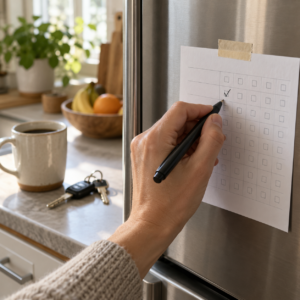
Lower the number of decisions between you and showing up.
Track consistency, not intensity
Early on, the goal isn’t to have your best workout. It’s to not miss twice in a row. One missed session is a normal life event. Two missed sessions in a row is how habits quietly die. If you skip a day, the only rule that matters is showing up again next time, without turning it into a moral failure that spirals into skipping a week.
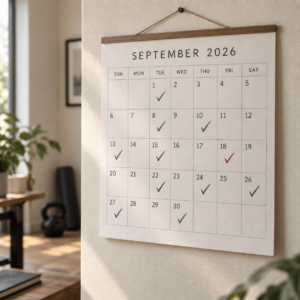
The goal isn’t a perfect month. It’s not missing twice in a row.
Let community do some of the work for you
Habits that rely purely on internal motivation are fragile. Habits with external accountability, a coach who notices when you’re missing, a class time where people expect to see you, are far more durable. This is part of why coached group formats tend to have better long-term adherence than solo gym memberships. You’re not just relying on your own willpower anymore; you’re relying on a system built to catch you when your motivation dips.
Building a habit isn’t glamorous, and it isn’t fast. But it’s the difference between a fitness routine that lasts a season and one that lasts a lifetime.
Ready to build a habit that actually lasts? Join a coached class at Blitz45 and let our system help you show up, even on the days motivation doesn’t.
If you have ANY inquiries, feel free to reach out to me via email. I genuinely appreciate hearing from you and personally respond to all your messages. Don’t hesitate to send me an email at derek@blitz45fitness.com anytime.
Derek L. Riley
President/Chief Growth Officer
For information about the Blitz45 franchise opportunity, please visit Franchise Opportunity